At least 19 people have died and four remain missing after nine days of heavy rain triggered floods, landslides and other weather-related incidents across Luzon in the Philippines, according to the Office of Civil Defense (OCD).
The prolonged rainfall, intensified by the enhanced southwest monsoon and recent tropical storms, has affected hundreds of thousands of families, forced residents into evacuation centres and disrupted transport across several regions. Schools and government offices have also been closed in affected communities, while flooding has disrupted roads and streets in Metro Manila.
The OCD said in its latest situational report that 12 people had died in landslides in Benguet. Four deaths in Rizal were linked to a rockslide, a fallen tree and drowning incidents, while three more deaths in Batangas were caused by drowning, electrocution and a landslide.
A further 15 people were injured in Ilocos Sur, Benguet, Rizal and Cavite in incidents involving landslides, vehicle accidents and strong currents. Four people remain missing in Batangas and Benguet.
Baguio Records More Than a Month’s Rain
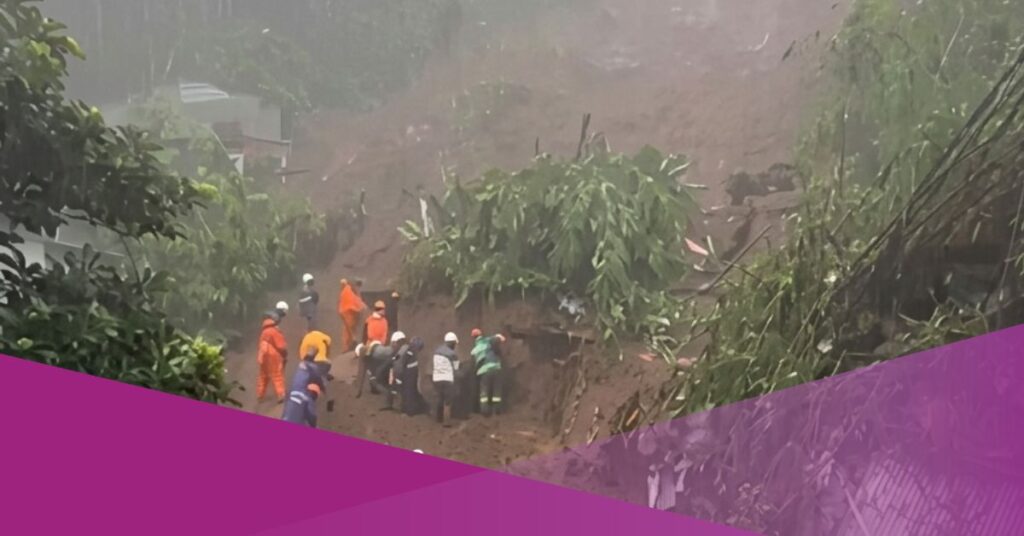
Baguio City has been among the worst-affected areas. Seven deaths were initially reported after a rain-soaked mountainside collapsed onto three houses. The latest OCD tally, however, places the number of landslide fatalities in Benguet at 12.
Rescue teams have continued working in difficult conditions, with heavy rain increasing the risk of further landslides.
“Rescue efforts are continuing, but they are doing it manually because of the heavy rain,” rescuer Esther Banawe told Agence France-Presse (AFP) in Baguio City.
She said the operation was being supervised by a designated safety officer because of concerns over additional landslides.
State weather forecaster Dan Villamil said on Monday that rainfall in Baguio, located about four hours north of Manila, had already exceeded the city’s typical monthly total.
“The rainfall recorded for August 1-9 was highest in Baguio, with an accumulated 1,413.2 millimeters (56 inches),” he said.
Baguio normally records 963.2 millimetres of rain during August, meaning rainfall during the first nine days of the month was about 47 per cent higher than the city’s typical total for the entire month.
Parts of Metro Manila had also received rainfall equivalent to about 90 per cent of the area’s typical August rainfall.
Although heavy rain continued on Monday evening, Public Works Secretary Vince Dizon said floodwaters were beginning to recede.
“Our interventions are continuing, but we really need to fix the years and decades’ worth of faulty flood mitigation interventions,” Dizon told reporters.
His comments referred to a wider scandal involving alleged bogus flood-control projects, which authorities have said resulted in billions of dollars in losses to taxpayers.
More Than 2 Million People Affected
According to the OCD, the latest series of weather disturbances has affected around 646,676 families, or approximately 2.2 million people, across Ilocos Region, Cagayan Valley, Central Luzon, Bicol Region, Western Visayas, Zamboanga Peninsula, the Cordillera Administrative Region, Calabarzon and Mimaropa.
Around 94,997 people from 26,174 families were staying in 919 evacuation centres. Infrastructure damage was estimated at PHP1.4 billion, while agricultural losses reached approximately PHP135.33 million.
The government has so far provided PHP73.52 million in assistance to affected communities.
The Philippine National Police (PNP) has also deployed frontline personnel and resources to support search and rescue, evacuation and relief operations in areas affected by flooding.
PNP chief Gen Jose Melencio Nartatez Jr said the police had made additional personnel and resources available for emergency operations and urged the public to follow official information channels rather than share unverified reports.
Flooding and traffic disruption caused by the enhanced southwest monsoon, known locally as habagat, and tropical cyclones Luis and Maymay have affected major roads across Luzon. Police units have been assisting communities in Central Luzon, while roads and a bridge in parts of Bulacan and Pampanga have remained impassable.
The Philippines faces an average of around 20 tropical storms and typhoons each year because of its location along the Pacific cyclone belt. Scientists have also warned that human-driven climate change is contributing to more frequent, prolonged and intense extreme weather events.